
Mexico’s Heavy Oil Opportunity: When the Challenge Isn’t the Reservoir, It’s the Flow
Mexico at a Crossroads
Mexico has long been one of the world’s most important oil-producing nations, with substantial heavy oil resources playing a key role in its energy future. While exploration and reservoir performance often dominate industry discussions, many mature assets face a more immediate challenge: producing heavy crude economically and efficiently.
In fields across southeastern Mexico, operators are working with oils that can be several thousand times thicker than water. The resource is there, the infrastructure exists, but getting heavy crude from reservoir to surface remains one of the industry’s most persistent technical hurdles.
As operators seek to maximise recovery from existing assets, attention is increasingly turning towards technologies that can address flow assurance challenges at their source.
When Oil Behaves More Like Molasses
Heavy and extra-heavy crudes can reach viscosities between 2,000 and 6,000 cP, particularly within fields such as the Samaria-Luna Asset in Tabasco.
At these viscosities, production becomes a constant battle against fluid resistance. Oil that is heated to improve flow often cools as it travels up the wellbore, causing viscosity to increase once again. The result can be lower production rates, increased operating costs and recurring intervention requirements.
It’s a challenge familiar to heavy oil operators worldwide: not a shortage of hydrocarbons, but a difficulty in mobilising them efficiently.
Why Temperature Matters More Than You Think
The challenge with heavy oil isn’t simply that it’s thick. It’s that viscosity changes dramatically with temperature.
As the chart below illustrates, even relatively modest increases in downhole temperature can significantly reduce viscosity across a range of heavy crude grades. In practical terms, this means oil that struggles to flow can become substantially more mobile with targeted heating.
For operators, the benefit extends beyond a lower viscosity measurement. Improving fluid mobility can reduce resistance to flow, ease the load on artificial lift systems and help maintain production performance as fluids travel to surface.
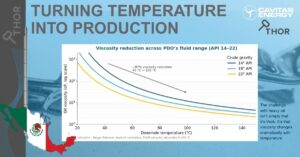
Representative heavy-oil viscosity response to temperature. The relationship highlights why targeted downhole heating can be an effective strategy for improving fluid mobility in heavy oil applications.
Rethinking Where Heat Is Applied
Traditionally, viscosity management has focused on applying heat from the surface. However, a growing number of technologies are shifting that strategy downhole, targeting the problem where it begins.
One example is THOR, Cavitas Energy’s downhole heating technology, which generates thermal energy directly within the wellbore. Using a Permanent Magnet Motor and proprietary friction-heating system, electrical power is converted into heat downhole, helping reduce viscosity before the fluid starts its journey to surface.
By addressing viscosity at the source, operators can improve fluid mobility and reduce the impact of heat loss during production.

Expected impact of intake fluid viscosity on pump run-life and uptime.
Data Matters
While new technologies often attract attention, long-term field performance remains the ultimate measure of success.
In heavy oil deployments, THOR has demonstrated:
Production increases from approximately 22 stb/d to 122 stb/d
Surface viscosity reductions from approximately 6,380 cP to 538 cP
Validation across heavy oil applications in California, Kuwait and Utah
The results highlight a broader industry lesson: when viscosity is the primary production constraint, addressing that challenge directly can unlock significant gains.
Matching Technology to the Challenge
Of course, not every reservoir challenge has the same solution.
Some fields are limited by permeability, reservoir compartmentalisation or natural energy. Others are constrained by fluid behaviour. Understanding the difference is critical.
As Mexico continues to maximise value from its mature assets, success will increasingly depend on identifying the true barrier to production and selecting technologies designed to address it.
For heavy oil operators, that may mean a simple shift in thinking: rather than asking how to produce more oil, first ask what’s preventing it from flowing.
Connect with us: Cavitas Energy LinkedIn
Email: info@cavitas.co.uk
Give us a Call: +44 (0) 1224 011130